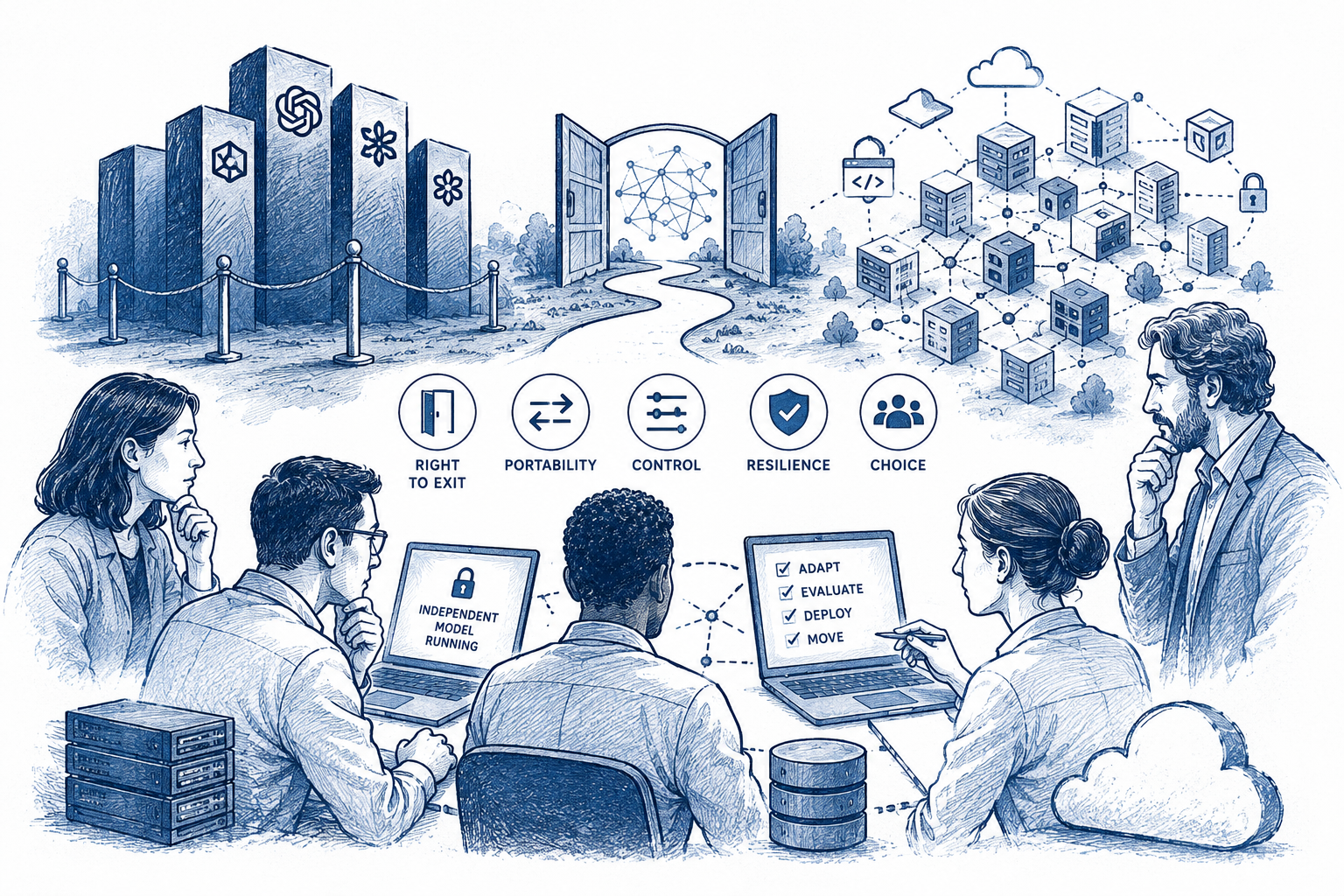
The argument over open AI is usually staged as a contest between American frontier labs and Chinese model developers. But that framing is potentially too small.
What is being decided is whether intelligence becomes a proprietary service rented from a handful of companies, or an industrial input that companies can possess, adapt and embed in their own systems.
Open-weight models do not need to beat the frontier labs to change that outcome. They do not even need to reproduce the collaborative development model that made Linux successful. What they do need to give buyers is a credible right to exit.
That right changes the market. It constrains pricing, limits the power of model providers to dictate acceptable uses, reduces exposure to product retirements and policy changes, and gives companies some control over infrastructure that is becoming central to how they operate.
Closed models will probably continue to define the frontier. They will remain the best place to test new capabilities first. They may also remain the better option for workloads where operating a model independently creates more complexity than value.
But they are unlikely to become the permanent operating layer of the entire AI economy. Markets this large are rarely built by asking every participant to depend indefinitely on the same three suppliers.
Disclosure: I run an AI insurance MGA whose business benefits from broader AI deployment, including demand for AI liability. I have no commercial interest in whether the underlying models are open or proprietary.
Most of what gets called open-source AI is actually open-weight AI.
The Open Source Initiative defines openness around four freedoms: the ability to use, study, modify and share a system. Meeting the full standard requires access to more than the final weights. It requires training code and enough information about the data and development process to study and reproduce the system meaningfully.
Kimi, DeepSeek, Qwen, GLM and Llama release their weights but disclose relatively little about how the models were built. Ai2's OLMo and BLOOM come closer to the full definition. Almost none of the models with significant commercial adoption do.
That distinction matters enormously for scientific research, transparency and accountability. And it matters less for market structure than the purists sometimes suggest.
A company does not need to reproduce a model from first principles to reduce its dependence on the company that trained it. It needs the legal and technical ability to hold the weights, run the model, adapt it, evaluate it independently and move it between infrastructure providers.
Open weights do not provide complete openness. They provide portability. Portability creates the possibility of an exit.
That is not the same thing as saying that switching models is easy. At the API layer, it can look like a routing change. In production, the move may reveal how much of an application has been designed around one model's particular behaviour, tool use, prompting patterns, safety policies and failure modes.
A company has a credible exit only when it knows how long migration would take, what performance it would lose and which parts of the system would have to be rebuilt. The measure is engineer-weeks to move production traffic, not the licence terms or whether the application uses a standard API. Even an imperfect exit right is materially different from having none.
Three days after Claude Fable 5 went online, a US export order forced Anthropic to cut access for foreign nationals. Selective compliance was not possible, so access went dark. The controls were lifted on 30 June and access restored on 1 July. However, every business built on that endpoint was subjected to a shutdown with no warning.
An independently operated model removes the original provider's direct ability to discontinue the endpoint, change its usage policies, restrict a class of customers or reprice the service without giving the buyer another option.
It does not eliminate dependency. The deployment may still rely on cloud infrastructure, restricted chips, proprietary serving tools, external security updates or licence conditions. But, it changes the dependency structure. That optionality becomes important as models move from experimental interfaces into core business systems.
The case for open models is often built on a loose analogy to Linux. That analogy needs to be handled carefully.
Nobody submits a patch to a weight file. There is no simple contribution flywheel in which ten thousand developers each fix the part that annoys them and the shared artefact steadily improves. That property is what made Linux, PostgreSQL and PyTorch compound. Contribution was relatively cheap, improvements were legible and forking was credible.
Model development is different. Improving a base model still requires data, specialised expertise, infrastructure and a training run that only a limited number of organisations can afford.
With software, forking could mean taking the existing code and continuing development in another direction. With weights, forking often means fine-tuning, compressing or renaming a model whose underlying capabilities remain the product of the original training run.
Open weights therefore deliver less than the open-source movement sometimes claims. But they deliver more than the frontier labs tend to admit. They do not necessarily decentralise model development. They decentralise model operation. That is enough to affect who holds power in the market.
The standard objection is that history does not support the open-model thesis.
Microsoft built one of the great software businesses on proprietary code. Apple controls its silicon and operating system. Google retains enormous influence over Android. Amazon, Microsoft and Google dominate cloud computing even though the cloud runs on vast amounts of open-source software. All true.
While open source did not prevent large companies from forming, it did prevent a single proprietary product from controlling every layer of the market.
Linux never displaced Windows on the consumer desktop, where it still sits at roughly 3%. It took almost everything else: around 90% of public cloud infrastructure, and every machine on the TOP500 supercomputer list since November 2017. Enormous proprietary businesses were then built above and around it.
Android did not weaken Google. Google used an open operating core to recruit handset manufacturers, chip companies and mobile carriers into an alternative ecosystem to Apple. It then captured value through search distribution, Play Services, the Play Store and other proprietary control points. Android holds roughly 67% of the global mobile market. None of the margin sits in the open part.
Chromium commoditised much of the browser engine while reinforcing Google's position in search and advertising.
Kubernetes made container orchestration broadly available while helping cloud providers sell managed infrastructure.
PyTorch broadened access to deep-learning development while increasing demand for accelerators and cloud compute.
The historical lesson is not that open source eliminates concentration.
It commoditises one layer and pushes the margin somewhere adjacent.
Nvidia's model releases are best understood through this lens.
The company benefits from a world in which many organisations can build and deploy models. It benefits less from a world in which a few laboratories operate the entire market and become large enough to design more of their own infrastructure.
Nemotron 3 Ultra, published on 4 June, came with the weights, the training data, the recipe and the reinforcement-learning environment, released under the Linux Foundation's OpenMDW licence. That is more disclosure than any frontier lab has offered, from a company with no model business to protect.
Publishing models is not an act of ideological conviction. It is an attempt to compress the margin of a complementary layer and expand demand for the layer Nvidia controls.
The same logic applies to cloud providers, enterprise software companies and application developers. They may disagree on many questions, but they share an interest in preventing the foundation-model layer from absorbing the economics of the entire stack.
In July, Hugging Face, Meta, Microsoft, Mistral and Nvidia jointly opposed restrictions on open weights. The breadth of that coalition matters more than the purity of its motives.
The frontier labs would prefer buyers to think of the model as the finished product.
A user submits a request. The model produces an answer. The provider charges for access. That framing made sense during the chatbot phase of AI.
It becomes less convincing as models are embedded inside underwriting engines, factories, hospitals, vehicles, banks and government networks. In those settings, the model is one component in a much larger operating environment.
The deploying organisation still has to decide:
The commercial value accumulates in this surrounding apparatus: proprietary data, workflows, integrations, memory, tools, evaluations, controls and operating experience.
The model is not the operating system. The operating system is being built above it.
This is increasingly described as the harness: the orchestration loop, tools, memory, sandboxes, permissions and interfaces that turn a model into a system capable of completing work. The better the harness becomes, the less obvious it is that the foundation-model provider will own the customer relationship.
A bank may happily prototype a credit assistant on a frontier API. It is less likely to accept indefinite dependence on one vendor's pricing, retirement schedule, usage policy and risk appetite once the system is embedded in credit operations.
A manufacturer may use a hosted model to test an inspection workflow. It may make a different decision once that model is involved in plant operations and downtime risk.
A government may value a frontier model's capability. It will also care whether access to that capability can be changed by another government, a vendor policy team or a commercial dispute. More than seventy national AI strategies are now live, and the European Commission has proposed an open-source-first rule for public AI procurement.
Self-hosting does not make a company sovereign in any absolute sense. It does remove one direct point of control.
For a business, that is a hedge.
For a government, it can be the difference between owning a capability and having permission to use one.
Two things make foundation models harder to hold than the platforms that came before them.
Conventional software functionality generally had to be rebuilt through engineering.
Model capability can be approximated through published research, synthetic data, reinforcement-learning environments, distillation and observation of other systems' outputs.
That does not make every method lawful, legitimate or equally effective. It does mean that capability spreads differently from ordinary software.
A laboratory can spend billions discovering a new capability and watch a useful approximation appear much faster than a traditional software platform could have been recreated. The UK AI Security Institute currently measures the strongest open models as performing comparably to closed systems released four to seven months earlier, narrowed from six to ten months through most of 2025.
The frontier remains expensive.
The usable frontier depreciates. The price of a given level of capability has fallen roughly 50x in three years.
This is one reason open models can matter even while trailing the best closed systems. Most of the economy does not operate at the absolute frontier. It operates at the point where capability becomes reliable and inexpensive enough for a specific task.
Frontier laboratories frame competition around benchmark leadership.
Buyers frame it around whether a system completes a task reliably, privately, quickly and cheaply enough.
Once a model is sufficiently capable for document extraction, claims classification, customer support, code migration or procurement analysis, additional general intelligence may have little commercial value on that workload. Once volume is large enough, price differences come under review.
Linux Foundation analysis of OpenRouter traffic found closed models taking roughly 80% of usage and 96% of revenue, at around six times the cost per call for comparable capability. That premium survives while usage is experimental. It gets harder to sustain when the model is processing millions of repetitive transactions. Uber capped employee AI spending at $1,500 a month in June after burning through its budget in four months, with some engineers billing $500 to $2,000 monthly.
This is the economic opening for downloadable models, where they do not have to be better, but be good enough, controllable enough and materially cheaper at the workloads that consume the most volume.
The uncomfortable fact in the open-model argument is that many of the most competitive downloadable models are Chinese.
Research across roughly 851,000 Hugging Face models and 2.2 billion downloads found American industrial dominance of the open ecosystem declining while Chinese laboratories, community organisations and unaffiliated developers gained share.
That does not necessarily indicate a permanent Chinese advantage. It reflects different incentives.
American frontier labs found a lucrative route through closed APIs, subscriptions and enterprise contracts. Chinese laboratories, facing compute constraints and intense domestic competition, had stronger incentives to optimise for efficiency and release their models broadly. And US export controls may also have reinforced this pattern.
Restrictions on advanced hardware increased the value of efficient architectures and made it harder for Chinese developers to build large centralised inference businesses. Releasing weights allowed other organisations to bear the cost of serving the models.
That interpretation is notable even when made by representatives of American frontier labs. It suggests that export controls may have accelerated the very open-model ecosystem that US policymakers now view with concern.
China's approach is also explicitly industrial policy. The State Council's AI Plus initiative and the current Five-Year Plan both treat open-source proliferation as a directive rather than a preference. Open releases support domestic adoption, international influence and a broader ecosystem around Chinese model families.
A subsidised ecosystem is not the same thing as a fully competitive market. It may carry security, provenance and geopolitical risks that commercial buyers cannot ignore.
But it also does not follow that the future of open weights must belong to China.
American and European open models do not need to dominate every benchmark. They need to become capable enough that companies can choose among several model families without returning to permanent dependence on a closed endpoint. The plausible end state is not one dominant open model.
It is a competitive inventory of downloadable models from several countries, optimised for different industries, languages, devices, infrastructure environments and risk appetites.
The leading laboratories continue spending heavily to build the most generally capable systems. Their models are used for novel work, difficult research, advanced coding and early experimentation.
Open models trail by four to seven months but become the default for stable, high-volume production workloads.
The labs remain important and valuable. They simply stop collecting a toll on every unit of intelligence consumed by the economy. And to me, this is the most likely outcome.
It is failing if the measured capability gap widens on its next reading. Four to seven months is already narrower than the six to ten months recorded through 2025.
Enterprises hold model portfolios rather than choosing a single provider.
A company might use a frontier API for difficult reasoning, a self-hosted model for sensitive work, a compact model on devices and several domain-specific models for repetitive processes. The model becomes a procurement category and a routing decision rather than a permanent platform commitment.
The winners in this market are likely to include orchestration platforms, inference providers, evaluation systems, security companies and firms capable of governing heterogeneous model estates.
This outcome is already emerging. Roughly half of developers adding AI functionality now use both open and closed models rather than committing to one. It strengthens if that share keeps growing rather than consolidating.
Algorithmic gains, synthetic data, sparse architectures and better training methods close the remaining capability gap.
A small number of well-funded organisations produce base models while a much larger ecosystem compresses, adapts and distributes them. Competitive advantage then moves toward proprietary data, customer distribution, domain expertise and the ability to operate AI systems reliably.
This is the scenario that poses the greatest threat to current frontier-lab valuations.
It is also the least clearly supported today, and the current trajectory makes it less likely. The Chatbot Arena gap between the best open and closed models collapsed to 0.5% in August 2024 and DeepSeek-R1 briefly matched the leading US system in February 2025. By March 2026 the gap had reopened to 3.3% as closed reasoning models pulled ahead.
A serious misuse or security incident leads to licensing requirements, release thresholds, restricted repositories or bans on particular foreign-origin models. This slows open deployment at the top end of capability. However, it does not necessarily restore a global oligopoly.
Governments and strategically important industries will still want systems they can operate without depending on a foreign commercial endpoint. The likely response is nationally approved open models, regulated weight repositories and sovereign deployment environments. Restriction therefore fragments the open ecosystem geographically rather than eliminating it.
The world may end up with American, Chinese, European, Gulf and Indian model ecosystems, each shaped by different infrastructure, security and governance requirements. And these outcomes are not mutually exclusive.
The most plausible market is closed leadership at the frontier, hybrid enterprise deployment and increasing geographic fragmentation around sovereign model ecosystems.
Open models will not win merely because open source has moral appeal. There are several ways the thesis could fail.
That advantage may come from proprietary interaction data, better agent environments, exclusive compute, integrated distribution and continuous learning from real-world use.
The evidence is increasingly visible in the harness.
Weights alone do not create a useful agent. The surrounding orchestration, memory, tools, permissions and execution environment can be more important than small differences in benchmark performance.
An independent scaffold may temporarily outperform a laboratory's first-party product. On Terminal-Bench in May, a third-party harness running Anthropic's own weights beat Claude Code by 21.8 points. Eight weeks later the labs had absorbed the same techniques, and the spread at the top of the board had compressed to roughly three points.
Open models do not yet have an equivalent first-party product and distribution loop. None currently appears in the verified top tier. If the harness becomes the primary source of capability and the frontier labs own the best harnesses, access to the weights may matter less than open advocates expect.
Android is the case in point. An open foundation can support a broad ecosystem while one company owns the most valuable control points above it.
The same structure is possible in AI. Open weights could become widely available while cloud providers, chip companies, agent networks or application platforms control customer access and capture most of the margin.
Open models would still prevent the foundation-model labs from owning the market. They would not necessarily produce a decentralised one.
Developer adoption of open models is already substantial. In Mozilla and SlashData's 2026 survey of 1,410 developers, 79% of those adding AI functionality use open models, against 71% for closed.
Reaching production is a different story. Only 51% of open-model teams get there, against 63% for closed.
The gap does not disappear automatically inside larger companies. Closed production rates climb from 54% to 73% as company size increases. Open rates move from 53% to 57%.
Enterprises can often buy their way through closed deployment because the provider supplies the infrastructure, tooling, security controls and support. Open deployment still depends on an operating stack that remains incomplete.
If that tooling does not improve, open models may remain important to developers without becoming the default choice for enterprise production.
Released weights cannot easily be recalled.
Modified versions can be difficult to trace, patch or govern. Safety tuning may be removed. Model provenance and training data are often poorly disclosed. A downloadable model can contain hidden vulnerabilities, biases, backdoors or intellectual-property problems.
Openness does not automatically create transparency.
Model availability is therefore not enough. The market requires provenance systems, evaluation infrastructure, security testing, liability rules and independent assurance.
It currently has early versions of all five.
The investment question is not whether open or closed models win.
It is which layer becomes scarce after the model becomes replaceable.
One measurement problem is worth resolving before answering it. Open models can lead in token volume on developer-oriented routers while closed models continue to dominate enterprise spending through Azure, Bedrock, Vertex and direct contracts. The same OpenRouter data that shows open models taking the majority of tokens shows closed models taking 96% of the revenue.
Usage share, revenue share and production share are different numbers. Anyone claiming that one proves the others is probably measuring the market they want to see.
The case for open models does not rest on communities being more virtuous than corporations.
It rests on the proposition that the model itself is unlikely to remain scarce enough to control the entire value chain.
Every major advance is observed by competitors. Research circulates. Staff move. Outputs can be studied. Architectures are published. Models generate training data for other models. Hardware improves. Smaller systems become more capable.
The cost of reproducing useful intelligence is falling faster than the cost of creating the first version of it. And that, is not a comfortable structure for a permanent oligopoly. The leading closed labs may become the Bell Labs of the AI era: institutions where important inventions happen and the hardest frontier work gets done.
Bell Labs did not own every product built with the transistor.
The strongest version of the open-model thesis is therefore not that open models will defeat closed ones. It is that they will prevent the closed-model layer from controlling the market.
Open weights create exit rights. Exit rights constrain supplier power. Supplier power moving downward pushes value into the data, workflows, orchestration, permission systems and assurance layers surrounding the model.
Open models are not guaranteed to produce a decentralised AI economy. Without them, however, we are unlikely to get much of a market at all. We will get several extraordinarily powerful landlords.
That is a much smaller future than the technology deserves.


Disclaimer: The insurance products described on this website are offered through surplus lines insurers. Surplus lines insurance is not subject to all the insurance laws and regulations of your state, and such insurers are generally not licensed by or subject to the supervision of the insurance department of your state. Coverage may not be available in all jurisdictions and is offered only through properly licensed surplus lines brokers.
Nothing on this website constitutes an offer to sell or a solicitation to buy insurance. No coverage will be bound or effective unless and until confirmed in writing by an authorized representative and all underwriting requirements have been satisfied. Any descriptions of coverage are for general informational purposes only and do not amend, modify, or supplement any actual policy or contract of insurance.
Please consult with a licensed surplus lines broker to determine availability and eligibility in your state.
Armilla Insurance Services is a Coverholder at Lloyd's. Affirmative AI Liability Insurance is underwritten by certain underwriters at Lloyd's. Not all activities are related to Lloyd's.