Why AI-specific insurance is showing up in enterprise contracts, and what to bring to the table
“By 2028, 90% of AI vendors and half of large enterprises building their own AI will use insurance-backed performance guarantees.”
IDC FutureScape: Worldwide Insurance 2025 Top 10 Predictions, October 2024
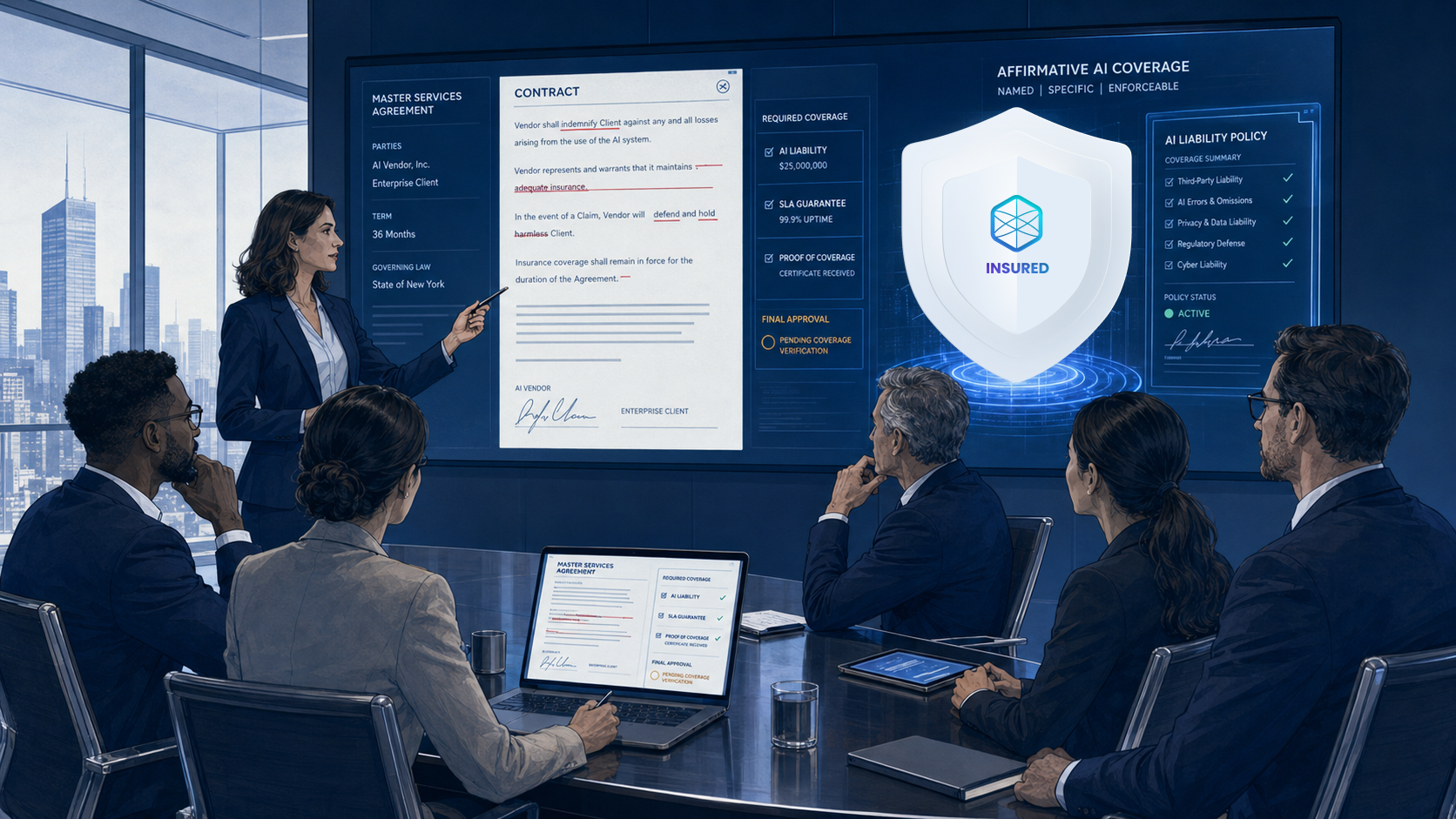
If you sell AI-powered solutions to large enterprises, from generative AI to AI agents, your customer contracts now require some form of AI insurance. The master service agreement (MSA) requires your company to indemnify the customer for inaccurate or harmful outputs; the SLA contains guarantees around AI performance and output outcomes; and procurement asks for proof of insurance covering AI-related risks, from hallucinations to bias, copyright infringement to compliance. Fortune 1000 buyers are writing these terms into purchase and renewal as standard conditions. You have cleared the technical review; the next question is whether your insurance covers you for what your AI agents do in production.
Key takeaways
Enterprise buyers learned from public failures what they now protect against in contract. In Mata v. Avianca, a federal court sanctioned attorneys who filed a brief built on case law ChatGPT fabricated. McDonald's famously ended an AI voice agent partnership after the voice system misheard orders and drew a biometric privacy class action. In Moffatt v. Air Canada, a tribunal held the airline liable for its chatbot’s incorrect fare advice. Buyers responded by asking their AI suppliers to indemnify them for hallucinations, biased outputs, copyright-infringing outputs, and non-compliant outputs, and increasingly to guarantee performance in writing. The Geneva Association found that nine in ten of 600 corporate insurance buyers signaled a need for dedicated coverage for generative AI (Gen AI Risks for Businesses, October 2025).
In Armilla’s underwriting pipeline, that requirement shows up deal by deal.
In each case the AI solution had already been approved, and the deal was waiting on proof of coverage.
Traditional coverage that most startups and scale ups carry was written before generative AI existed, which means it is most likely silent on AI: it neither clearly affirms coverage for these failure modes nor clearly denies it. Coverage for AI risk is either silent, ambiguous, partial and clear gaps are emerging. Many SLA commitments, providing guarantees around AI performance or outputs, fall under the standard contractual liability exclusion in tech E&O. If your product touches hiring or lending, bias and discrimination exposure often sits behind an employment practices liability (EPLI) exclusion. Insurers are also exploring AI exclusions across traditional lines and there is reason to expect them on faster timelines than silent cyber. A policy that never mentions AI cannot give procurement the affirmative evidence it is asking for and may ultimately leave both parties exposed. Gartner has advised general counsel to assess the need for AI insurance, and those general counsel review your contracts (Gartner, April 2026).
Armilla provides two options for start ups and scale ups that need to produce evidence of AI insurance coverage.
Both give procurement what it is requesting, which is named, affirmative coverage for AI risk rather than an argument about what an older policy should pay. Coverage is bindable in 24 hours, which matters when the insurance question is the last open item on a contract.
Before your next renewal, ask your broker three things in writing: whether the policy affirmatively covers AI claims, whether your contractual liability exclusion leaves your customer indemnities uninsured, and who decides if a loss was caused by AI.
Proof of coverage for AI risks is rapidly evolving into a standard procurement requirement for tech companies, the way SOC 2 did, from differentiator to box check before the deal starts. The providers who treat it as part of their go-to-market will spend their negotiating leverage on price and terms rather than on the insurance question.
To put affirmative AI coverage in front of procurement before your next renewal, contact us to scope a policy and identify a broker who can help. Brokers can get appointed to place it for their clients.
Armilla Insurance Services is a Coverholder at Lloyd's. Affirmative AI Liability Insurance is underwritten by certain underwriters at Lloyd's, backed by A-rated insurers including Chaucer, Axis Capital, and Convex.


Disclaimer: The insurance products described on this website are offered through surplus lines insurers. Surplus lines insurance is not subject to all the insurance laws and regulations of your state, and such insurers are generally not licensed by or subject to the supervision of the insurance department of your state. Coverage may not be available in all jurisdictions and is offered only through properly licensed surplus lines brokers.
Nothing on this website constitutes an offer to sell or a solicitation to buy insurance. No coverage will be bound or effective unless and until confirmed in writing by an authorized representative and all underwriting requirements have been satisfied. Any descriptions of coverage are for general informational purposes only and do not amend, modify, or supplement any actual policy or contract of insurance.
Please consult with a licensed surplus lines broker to determine availability and eligibility in your state.
Armilla Insurance Services is a Coverholder at Lloyd's. Affirmative AI Liability Insurance is underwritten by certain underwriters at Lloyd's. Not all activities are related to Lloyd's.